
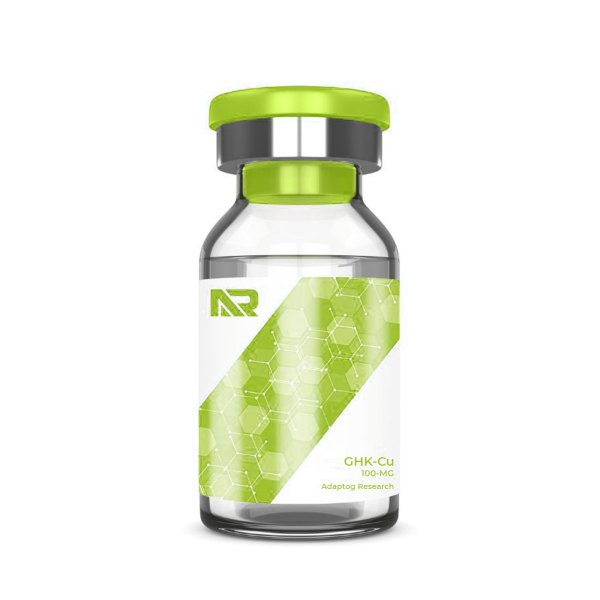
GHK-Cu 50mg
- Wound healing ✅
- Anti-ageing properties ✅
- Antioxidant potential ✅
- Anti-inflammatory ✅
GHK-Cu is a naturally occurring tripeptide-copper complex that can enhance tissue repair, anti-inflammatory, antioxidant, and wound-healing activities. It is most popularly known for its use in the cosmetic industry, where it is used to improve the health of skin and reduce signs of ageing, although its application extends beyond this, and it is currently also being investigated for additional medical uses.
Mechanism of Action
GHK-Cu exerts its activity by:
- Improving epithelial repair and upregulating tight junctions: The ability of the body to repair the mucous membrane and tight junction proteins is hampered by STAT3 activity, a protein that, when persistently activated, is linked to inflammation and diseases such as cancer and autoimmune disease. GHK-Cu activates and upregulates SIRT1, an enzyme that regulates the function of other proteins by deacetylating them, reducing the activity of STAT3. GHK-Cu exhibits additional anti-inflammatory activity even when STAT3 is silenced, indicating that it also influences other anti-inflammatory pathways [1].
- Reducing inflammation and protecting tissues: The elevated or chronic activation of NFκB and MAPK signalling pathways is associated with inflammation and disease. GHK-Cu suppresses MAPK and NFκB-mediated inflammation in certain tissues, decreasing inflammatory cytokines and reactive oxygen species (ROS) and increasing superoxide dismutase (SOD) activity [2].
- Reducing collagen deposition: In chronic fibrosis, TGF-β/Smad persistently signals, which leads to fibrosis and contributes to the progression of cancer. GHK-Cu down-regulates TGF-β1 and inhibits Smad2/3 activation. GHK-Cu can therefore attenuate processes involved in fibrosis and cancer metastasis [3].
- Increasing the activation of antioxidant genes: Nrf2 regulates antioxidant and detoxification genes and can protect against oxidative stress in chronic diseases [4]. The controlled delivery of copper by GHK-Cu is hypothesised to activate Nrf2, which in turn promotes the expression of genes that help to mitigate oxidative damage.
Therapeutic Potential
Studies have investigated the application of GHK-Cu in several therapeutic areas, including:
- Wound healing: Since GHK-Cu can reduce inflammation and enhance the repair of tissues, it is useful in wound healing applications. In tests on animal models, wounds showed faster contraction, better epithelialisation, more granulation tissue, and higher antioxidant enzyme activity [5,6]. In models of diabetes, wounds were found to heal faster, with lower TNFα and MMP-2/9 and increased collagen [7,8].
- Anti-ageing and cosmetic applications: GHK-Cu increases collagen and elastin production and enhances keratinocyte proliferation, increasing skin thickness, elasticity, and hydration [6]. In human trials involving women with photoaged skin, it increased skin density and thickness, decreased laxity, improved firmness and clarity, and reduced fine lines and wrinkle depth [9]. Another trial found that it reduced wrinkle volume by 55.8% and wrinkle depth by 32.8% [10].
- Lung health: It has demonstrated lung-protective activities in animal models of fibrotic lung disease, COPD, acute lung injury, and asthma, where it was found to reduce inflammation and fibrosis [2,11–13].
- Cognition and neurodegeneration: In animal models, it enhanced resilience to brain ageing [14] and delayed the cognitive impairment, amyloid plaques, and inflammation associated with Alzheimer’s [15]. Its effects on gene expression have been mapped and found to influence genes involved in neuronal development, maintenance, and synaptic function [9,16,17]. In models of brain injury, it helped recovery by reducing oedema, improving the survival of neurons, and reducing inflammation [18,19].
Safety
Most studies on GHK-Cu are preclinical, so there is limited data on its safety in humans. Based on results from studies on animal models and humans, GHK-Cu appears to be generally safe. It has demonstrated low skin irritability when applied topically, both with and without microneedle-assisted delivery. It has also been used directly on wounds to promote healing without causing any significant toxicity [20,21].
How It Compares to Pal-GHK
GHK-Cu is the tripeptide GHK complexed with a copper ion, while Pal-GHK is the GHK peptide bound to a palmitoyl group.
The purpose of forming the copper complex, GHK-Cu, is to enhance activity. GHK that occurs naturally in the body has a high affinity for copper and is involved in the binding and safe transport of copper throughout the body, where it is used by cells and enzymes as a cofactor. Since copper is essential for the activity of GHK, GHK-Cu is more bioactive than Pal-GHK [9].
The palmitoyl group of Pal-GHK enhances its ability to penetrate the skin, enabling it to pass into deeper layers of the skin when compared to GHK or GHK-Cu [22].
Overall, both Pal-GHK and GHK-Cu are associated with similar biological activities. The main differences between them are their potency and skin penetration, with GHK-Cu being more active and Pal-GHK being better able to deeply penetrate the skin. This makes GHK-Cu well-suited for medical and cosmetic applications where it can be delivered directly to target tissues or with assistive techniques such as microneedling.
Data Sheet
- Application: Research on wound healing, anti-ageing, pulmonary disease, and neuroprotection
- CAS Number: 49557-75-7
- Molecular Weight: 401.91
- Sequence: Gly-His-Lys (Cu²⁺)
- Chemical Formula: C₁₄H₂₂CuN₆O₄
- Synonyms: Copper Tripeptide-1, Glycyl-L-histidyl-L-lysine Copper Complex, Cu-GHK, GHK-Cu²⁺
- Storage: Keep refrigerated at 2-8°C until use. For long-term storage, keep at -20°C.
- Reconstitution: Reconstitute in sterile water. The reconstituted solution is stable for up to 30 days at 2-8°C.
- Organoleptic Profile: White to off-white lyophilised powder
- Physical Form: Solid
Conclusion
GHK-Cu is a tripeptide with biological activities that make it suitable for applications in wound healing, cosmetics, pulmonary disease, and neurological disease. Most of the tests conducted on this compound are preclinical, with only a few human studies published, which have found it to effectively reduce signs of ageing and improve skin health in humans.
| Milligrams (MG) |
50mg, 100mg |
|---|
Reviews
There are no reviews yet.